


Halfway between dressage, skill and the equestrian traditions of southern Europe, working equitation is still something of a curiosity for a large part of the northern European public. That may not last much longer. From 8 to 13 September, 74 combinations representing 22 nations will gather in Jerez de la Frontera for the 7th WAWE World Championship. Belgium will send only two riders, but not just anyone: Louise Poppe et surtout Virginie Dubuscurrently third in the world. Destination Andalusia, where opening a gate can count just as much as a flying change.
There are equestrian sports where one pole down ruins your Sunday. Others where people can debate for three hours over half a mark on a shoulder-in. And then there is this strange discipline.
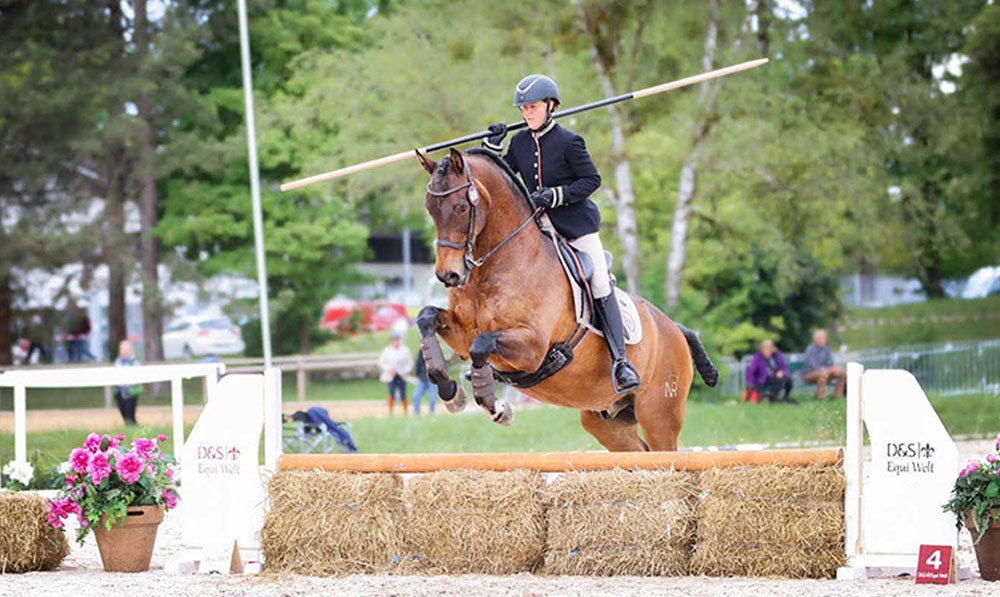
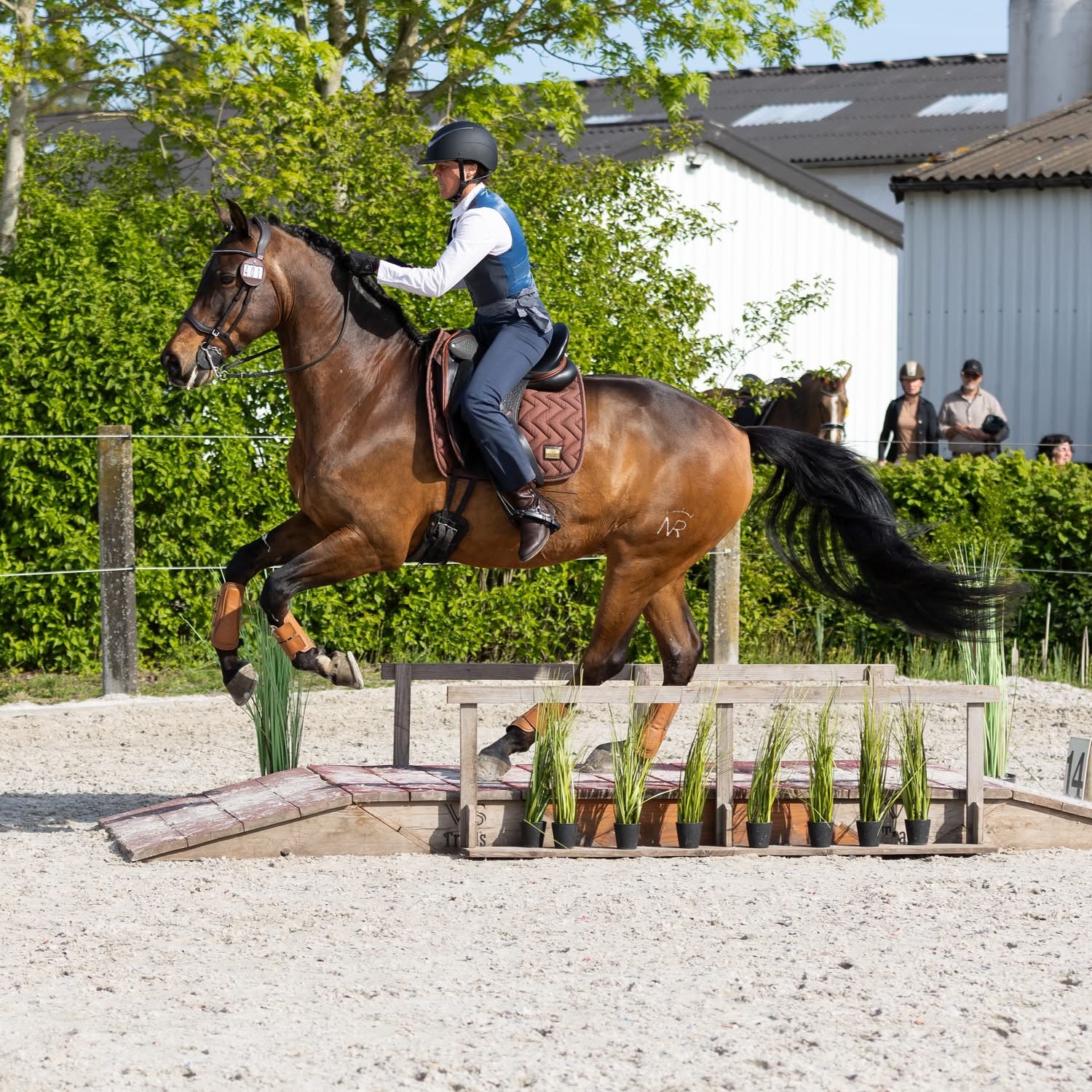
Here, the rider has to perform dressage, slalom, cross a bridge, open a gate, pick up a pole, negotiate different obstacles and sometimes sort cattle. All of it with style, precision, speed and, at the highest level, one hand on the reins.
Yes, one hand.
Welcome to a sport that borrows from everywhere: the finesse of dressage, the skill of a technical course and movements inherited from farm riders. On paper, the cocktail seems unlikely. On horseback, much less so.
When everyday movements become a sport
The discipline has its roots in the rural traditions of southern Europe, particularly Portugal, Spain, France and Italy. Long before judges’ marks and stopwatches, opening a gate without dismounting, crossing a narrow passage or handling a long pole were simply part of everyday life for certain riders.
« Originally, it really comes from farms, ” explains Jasmine Velghe, Belgian Chef d’Equipe. “You had to be able to open and close a gate on horseback, pick up a pole, go over a bridge… Then all of that was turned into competition."
And that is probably the best way to understand working equitation: once-useful gestures to which judges, points, a stopwatch and a serious dose of technique have been added.
nternationally, the discipline is now governed by the World Association for Working Equitation (WAWE).It therefore does not fall under the FEI, unlike showjumping, dressage or eventing. WAWE has its own rules, international competitions and world rankings.
n Jerez, it will stage the seventh edition of its Masters World Championship. An event that is starting to gain serious substance: 74 combinations from 22 nations are expected in Andalusia.
Niche, perhaps. Tiny, certainly not anymore.
Dressage, obstacles and the clock: three ways to lose your nerve
To understand the principle, imagine an eventing competition that has replaced the cross-country with a series of gates, bridges and slaloms.
First step: dressage.
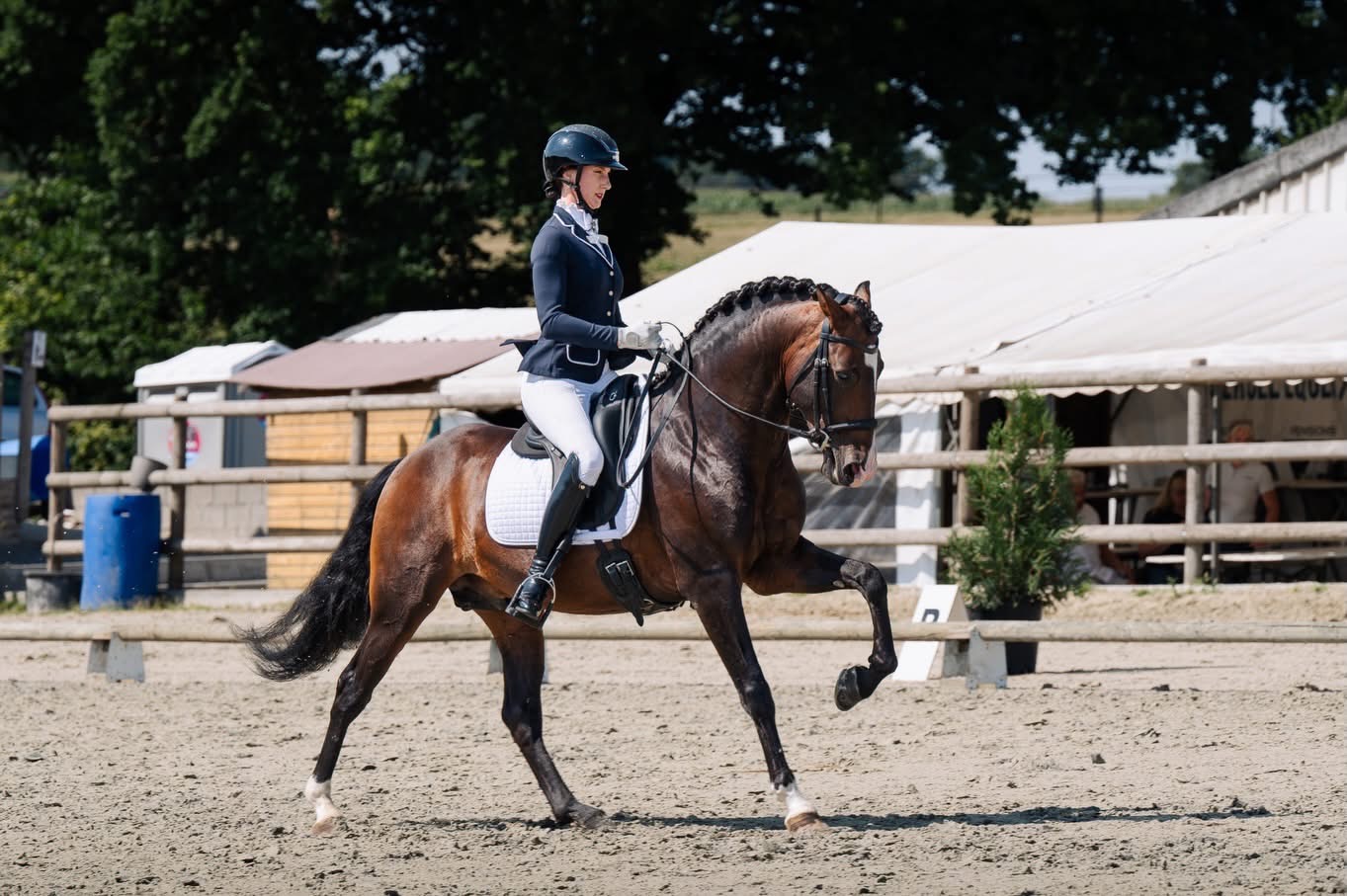
So far, nobody is lost. The combination performs a test in which the judges assess, among other things, balance, impulsion, contact, the horse’s availability and the rider’s precision. The higher you climb through the levels, the more serious the business becomes. Flying changes, canter pirouettes and collected movements are all on the menu for the best.
Then comes Ease of Handling., appelée Ease of Handling dans le règlement international.
This is where the personality of the discipline really appears.
Le couple doit enchaîner différents obstacles : ouvrir et refermer une porte, franchir un pont, effectuer un slalom, manipuler une perche ou encore négocier des passages étroits. Plus d’une vingtaine de types d’obstacles existent, même s’ils ne sont évidemment pas tous présents sur chaque parcours.
But be careful: simply getting through is not enough.
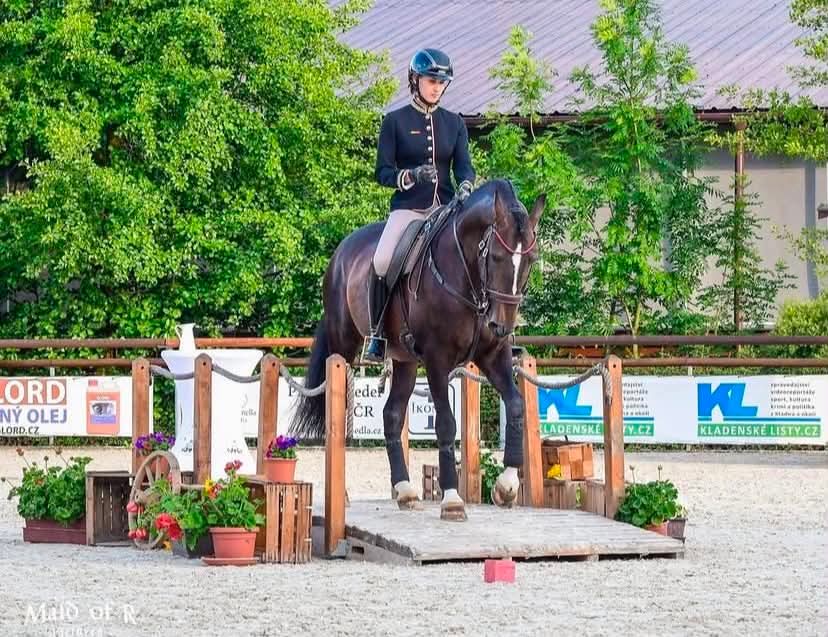
« “t is almost dressage between the obstacles ", Jasmine Velghe sums up. “Everything is based on elegance, harmony and the correct way of riding.”
The horse must remain available, balanced and free from tension. The rider must maintain the precision of the line and the quality of the aids. In short, anyone who thought they could escape dressage by going off to play with a bell may be in for a small disappointment.
Velghe smiles at that.
« Some people think: ‘Dressage is too difficult, I’ll do this instead." That is a big mistake. If your dressage is not good, the Ease of Handling will be even more complicated. "
Message received.
And Then Someone Starts the Clock
After precision comes the part that usually wakes up the stands: the speed trial..
The obstacles are still there. The philosophy changes completely.
This time, the aim is to complete the course as quickly as possible while avoiding faults. Lines get shorter, horses restart in just a few strides and riders attack every available second.
A slight whiff of a jump-off, then. Except that instead of stringing together 1.60m oxers, you may have to ring a bell, turn around poles or set off again after handling a pole.
And this is often where the atmosphere clearly moves up a notch.
À Jerez, les concurrents débuteront par le dressage mercredi et jeudi. La maniabilité suivra vendredi avant la vitesse samedi. Le dimanche sera notamment consacré au bétail et aux cérémonies finales.
And in the middle of all that, a cow
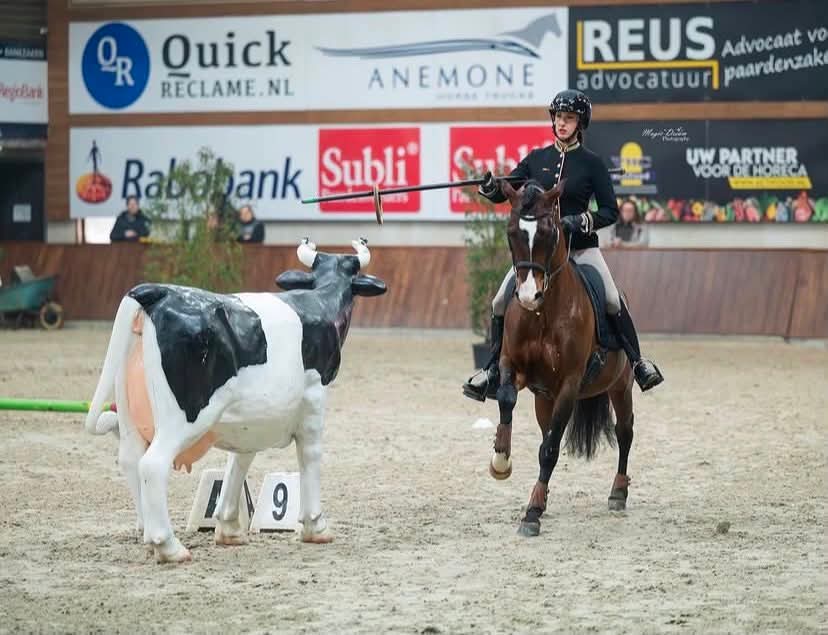
Parce qu’une porte, une lance et un chronomètre ne suffisaient manifestement pas, la compétition internationale conserve également une épreuve directement héritée des origines pastorales de la discipline : le tri de bétail.
The principle is simple to explain. Much less simple to execute.
A herd is placed in the arena. The rider must identify a specific bovine by its number, isolate it and then guide it towards a defined area.
For the Belgians, the exercise represents a particular challenge.
« We do not practise it much because we do not have many competitions with cattle in Belgium. ", Jasmine Velghe admits.
The rules have also evolved in order to better take animal welfare into account and to avoid the same herd being subjected to a succession of interventions that are too quick or stressful.
Unsurprisingly, the horses also have to be prepared. A horse that is perfectly relaxed in front of a dressage test can suddenly discover that a cow has a very personal opinion about the line being proposed to it.
At that level, improvisation is rarely a good strategy.
Virginie Dubus, the Belgian the Oohers already know
Belgium will travel to Spain with only two representatives. Not enough to contest the team ranking, for which three results are required.
But it is taking with it one of the riders who currently matter in the discipline.
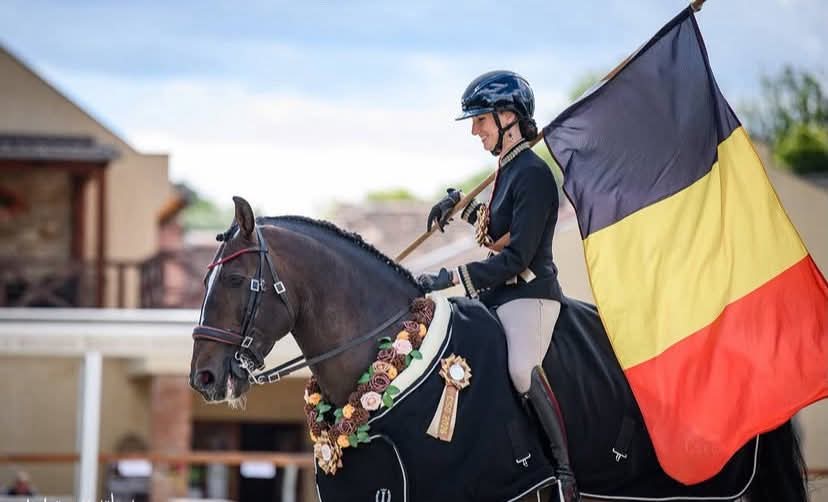
Virginie Dubus, Bruxelloise, occupe la troisième place du ranking mondial WAWE Masters avec 673 points. Devant elle, les écarts sont minuscules : la Suédoise Astrid Hedman pointe à 674,5 points et le Portugais Marco Boavista à 674.
In other words, nobody needs to pull out a scientific calculator to measure the distance separating the Belgian from the top.
With Hero des Nawies, Dubus has gradually made a name for herself well beyond Belgium’s borders.
« When I go to Romania or the Netherlands, people say to me: ‘Ah, you have Virginie!’” Jasmine Velghe says.
The remark says a lot.
n a discipline historically dominated by southern countries and long marked by a strong male presence, the Belgian has become an identifiable figure on the circuit. She also gives demonstrations and clinics abroad to promote her sport.
« She is truly an ambassador for the discipline ", Velghe insists.
And then there are the results.
Avec Hero des Nawies, Virginie Dubus avait terminé quatrième du Championnat d’Europe Masters 2024. Deux ans plus tard, le couple arrive à Jerez avec davantage d’expérience et un cheval que sa cheffe d’équipe juge encore meilleur.
Enough to talk about a medal?
Jasmine Velghe gently dodges.
« I do not want to put pressure on her. »
Obviously.
Hero, the home-made turbo
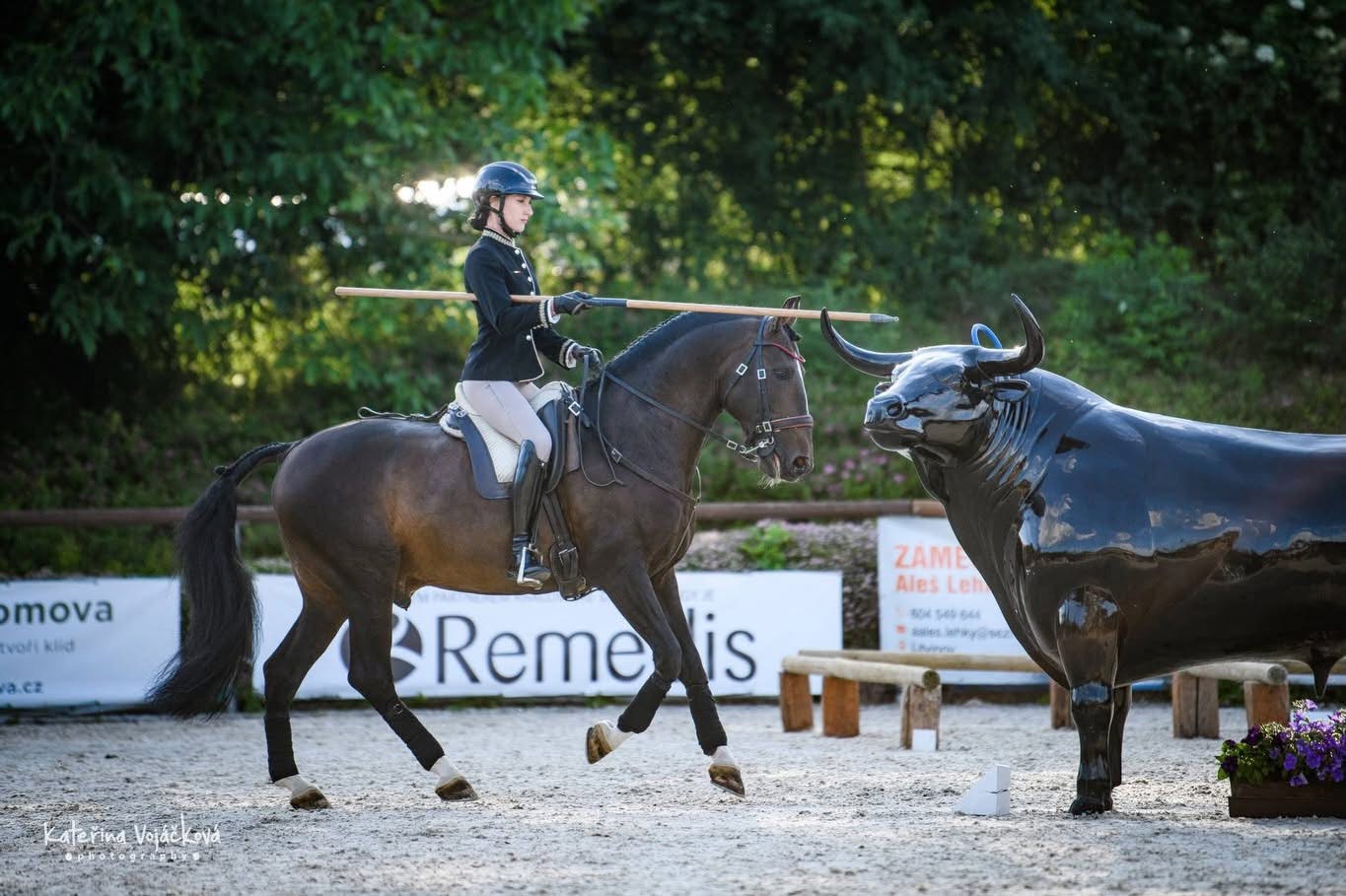
S
’il existe un secteur où le couple belge peut faire particulièrement mal, c’est la vitesse.
"Sheis really, really fast ", Velghe warns. “Hero and she make a very beautiful combination.” »
That is also what makes the format interesting. Being excellent in dressage is not enough. Being an aircraft against the clock is not enough either. The individual ranking rewards consistency across all three ridden tests.
So you have to be elegant when the judges are watching, precise when the obstacles arrive and fast when the stopwatch starts.
Easy.
Hero now has solid experience at the highest level. Virginie Dubus is also preparing the next generation with Othello, another horse she is gradually bringing up to Masters level and into international competitions.
But for Jerez, the boss remains Hero.
And given the speed of the duo once the clock starts, it is probably better not to blink.
Louise Poppe, Belgium’s second shot
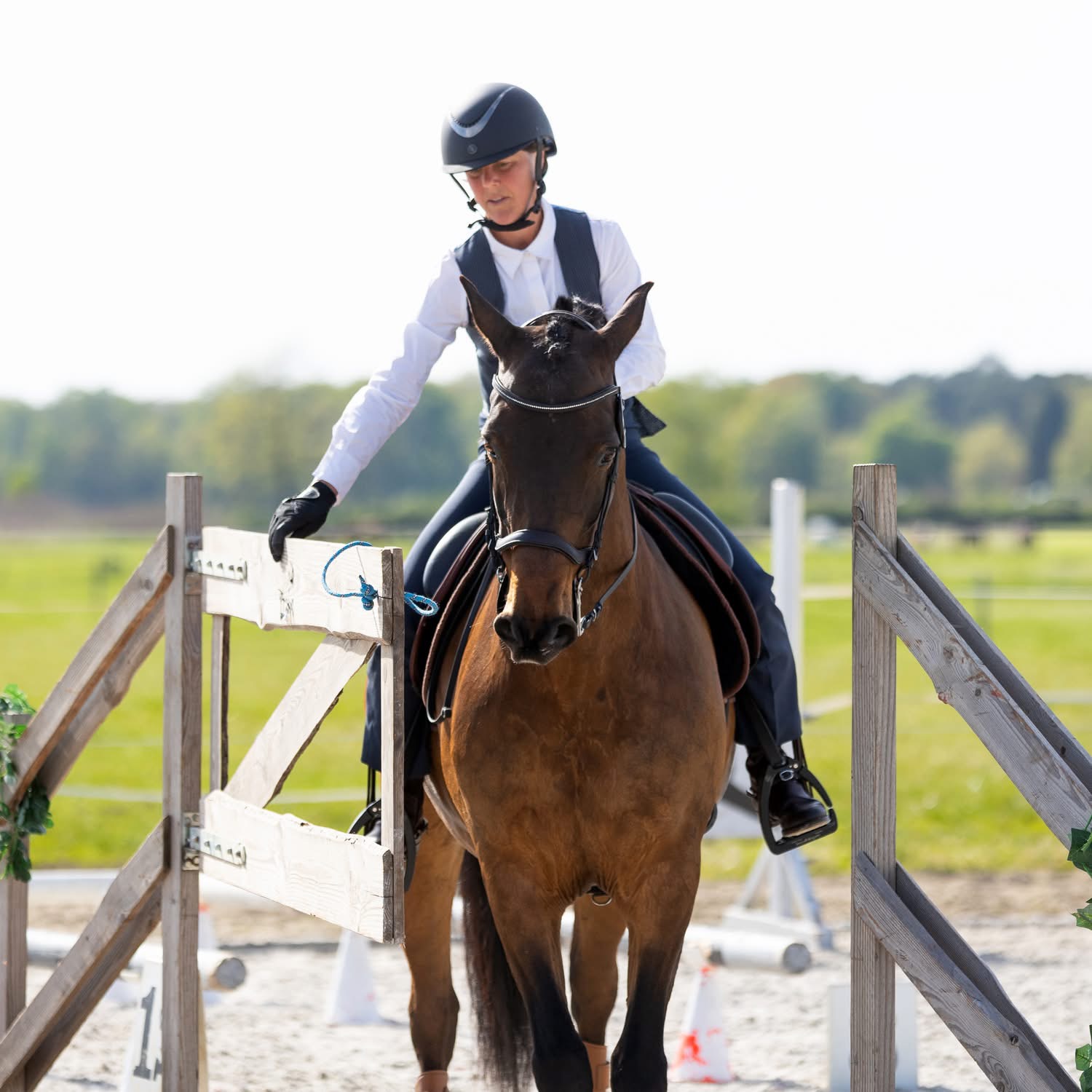
Alongside her, Belgium will field Louise Poppe, from the Genk region, with Herrador XXXI..
Less established than Dubus at the top of the international ranking, Poppe currently sits 70th in the WAWE Masters ranking with her horse. She nevertheless already has experience on the circuit and is one of the combinations competing at the highest Belgian level.
Her presence in Jerez also tells the story of a discipline still trying to broaden its base in Belgium.
Because behind the two riders selected for the Worlds, the Belgian pool at Masters level remains limited.
“We have a few Masters in Belgium, but not a huge number.” Jasmine explains.
Several experienced riders notably decided not to make the trip to Spain, sometimes because of the age of their horse and the length of the journey.
Result: two Belgians in Jerez, and therefore no possible team ranking.
It will have to be an individual game.
One hand on the reins, the other available
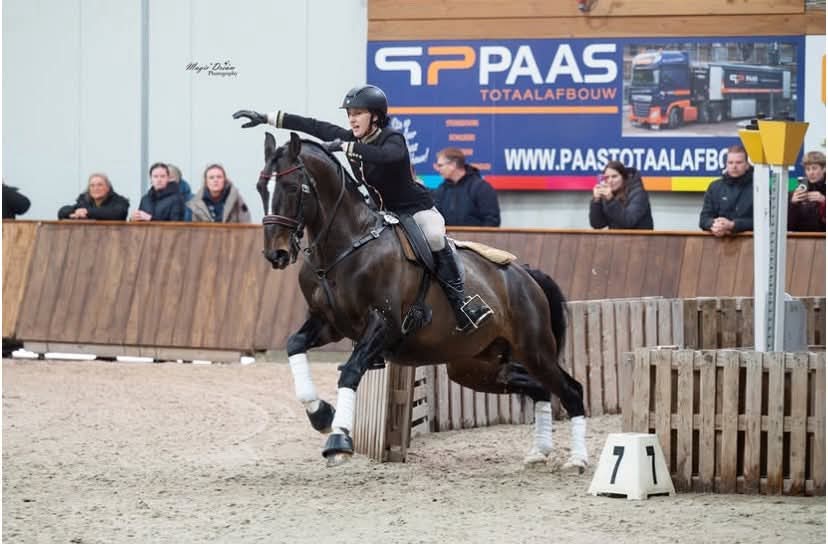
Another thing that immediately distinguishes Masters level is this: riders compete one-handed. main.
Dressage, Ease of Handling, speed: same deal.
The rule comes directly from the origins of the discipline. Historically, the rider had to keep one hand free to perform various tasks: handling a pole, opening a gate or working with cattle.
The tradition has remained.
And when you watch a combination string together flying changes, tight turns and technical obstacles with one hand on the reins, the “improved leisure riding” idea disappears quite quickly.
« They really are very skilful riders ” , Jasmine Velghe underlines.
Cette saison, le règlement international impose en outre l’utilisation de la main droite au niveau Masters. Un changement loin d’être anodin pour les cavaliers qui avaient construit pendant des années leurs automatismes de l’autre côté.
At this level, moving one hand can mean rewriting an entire part of the software.
In Belgium, you can start much more quietly
Fortunately, nobody will ask you to set off at a gallop tomorrow morning with a pole in one hand and the reins in the other.
Le système belge est construit autour de plusieurs niveaux progressifs : une catégorie d’entrée, puis W1, W2, W3 et W4, cette dernière correspondant au niveau Masters.
For beginners, the tests are simpler, the obstacles less complex and the speed trial is not immediately on the programme, notably for safety reasons.
Then the difficulty increases gradually.
The tests become more technical. The courses demand more control. Speed appears. All the way up to Masters level, where everything is done one-handed.
Les tests sont par ailleurs présentés en musique, ce qui contribue à donner aux épreuves une identité assez différente des disciplines classiques.
Belgium now has competitions in both Flanders and Wallonia, indoors and outdoors. According to Jasmine Velghe, the number of participants is increasing enough to create a new problem, and rather a pleasant one to have: finding more judges.
« Over the last two years, we have needed more judges because we have more competitors. »
There are worse signs of growth.
No, you do not necessarily need a Lusitano
Another particularity of working equitation is its accessibility.
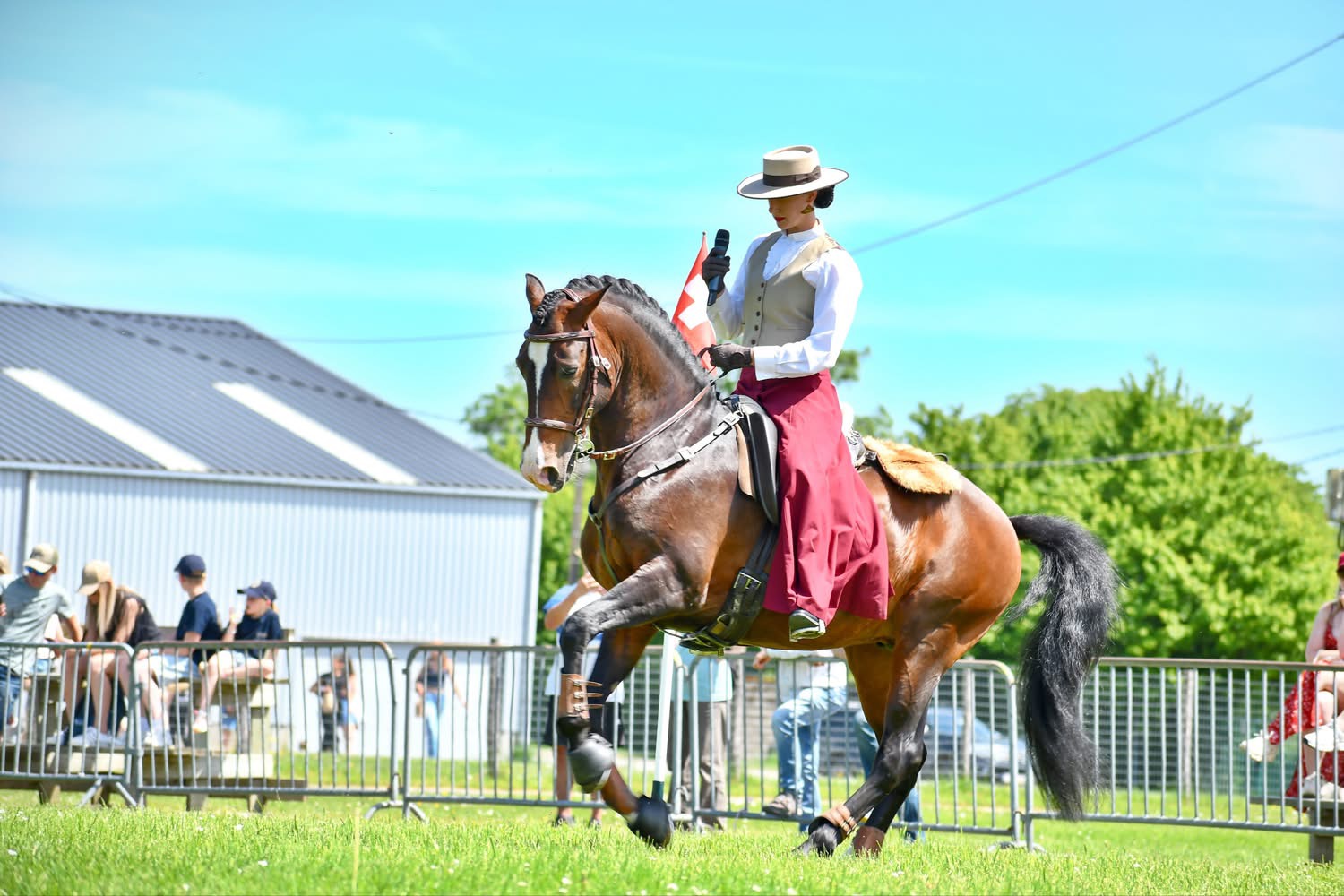
Images from major competitions show a lot of Lusitanos and Iberian horses. Logical enough: their aptitude for collection, their manoeuvrability and their ability to quickly change balance fit perfectly with the demands of the highest level.
But to get started, there is no need to immediately place an order in Portugal.
« In the lower categories, it does not matter whether you have a warmblood, a Lusitano or a Spanish horse." Velghe explains. “ We even have someone competing with a draft horse. »
What matters first is the relationship.
« It is mainly about harmony and the horse’s obedience, and the correct way you perform the obstacles. »
That may be one of the discipline’s best arguments.
For a rider who likes dressage but is looking for more variety, it offers an immense playground. For someone who does not want to jump big fences, it offers another form of technical challenge. And for the horse, the gates, bridges, slaloms and objects to handle break up the routine of the arena.
« The horses also like it because there is a lot of variety,” Velghe notes. “Everything is based on trust, harmony and technique. »
Three words that, in the end, sum the whole thing up pretty well.
Jerez, the perfect setting to step out of the shadows
Pour organiser un Mondial d’équitation de travail, difficile de trouver décor plus cohérent que Jerez de la Frontera.
The competition will take place at the Real Escuela Andaluza del Arte Ecuestre, one of the great temples of Spanish equestrian culture. There, the Iberian horse and traditional riding are not just postcard decoration.
And the event is gaining momentum.
There will obviously be a strong European presence, but also competitors from Canada, the United States, Brazil and Colombia, among others.
For a discipline still largely unknown to part of the Belgian equestrian public, the cast is starting to look seriously international.
Now it remains to be seen what the two Belgians can do with it.
Louise Poppe will be chasing her result with Herrador XXXI. Virginie Dubus and Hero des Nawies will arrive with a different status: that of a combination now identified by the best and installed very close to the top of the world.
Then, on Saturday, someone will start the clock.
And there, normally, Virginie will know exactly what to do.
(Photos ©Private collection)