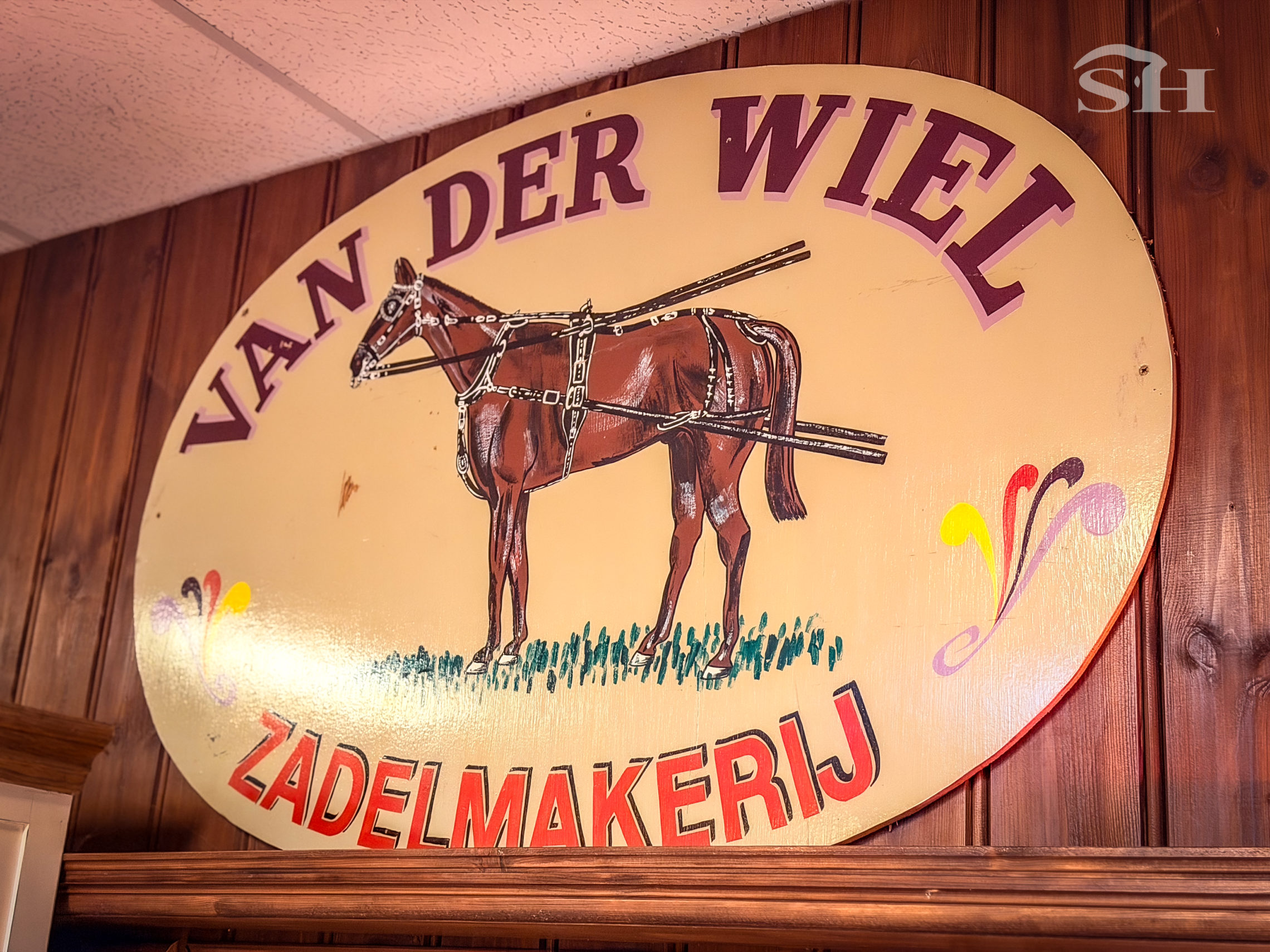


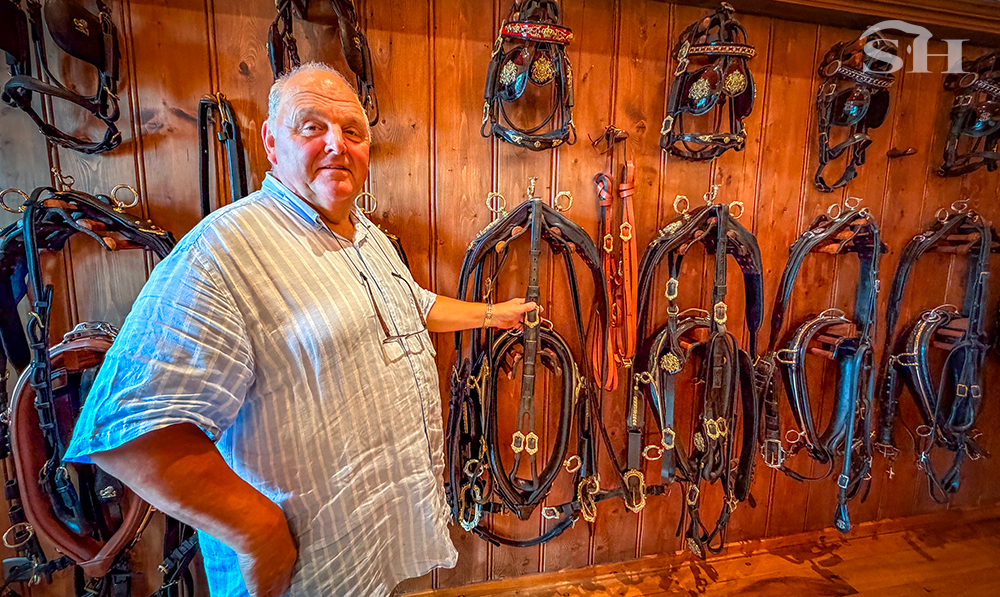
In Achel, in the far north of Belgium, the Dutch border is almost at the end of the pavement. In a former railway station turned strange palace of leather, Henk van der Wiel has spent decades making harnesses for world champions, royal houses and Sunday drivers. Here, there is no production line and no magic button: leather, metal, needles, hands and a great deal of time. Up to 600 hours for a single harness. A visit to an artisan who has dressed the world of driving without ever really leaving his village.
When you arrive in Achel, in Belgian Limburg, you almost have to brake before ending up in the Netherlands.
Belgium stops a few hundred metres further on. No grand avenue, no shiny industrial estate, and certainly no glass-covered headquarters to announce that one of the best-known names in the small world of driving is hidden here. Just an old station, Achel-Statie, sitting there as if it were still waiting for a train that will never come.
You knock.
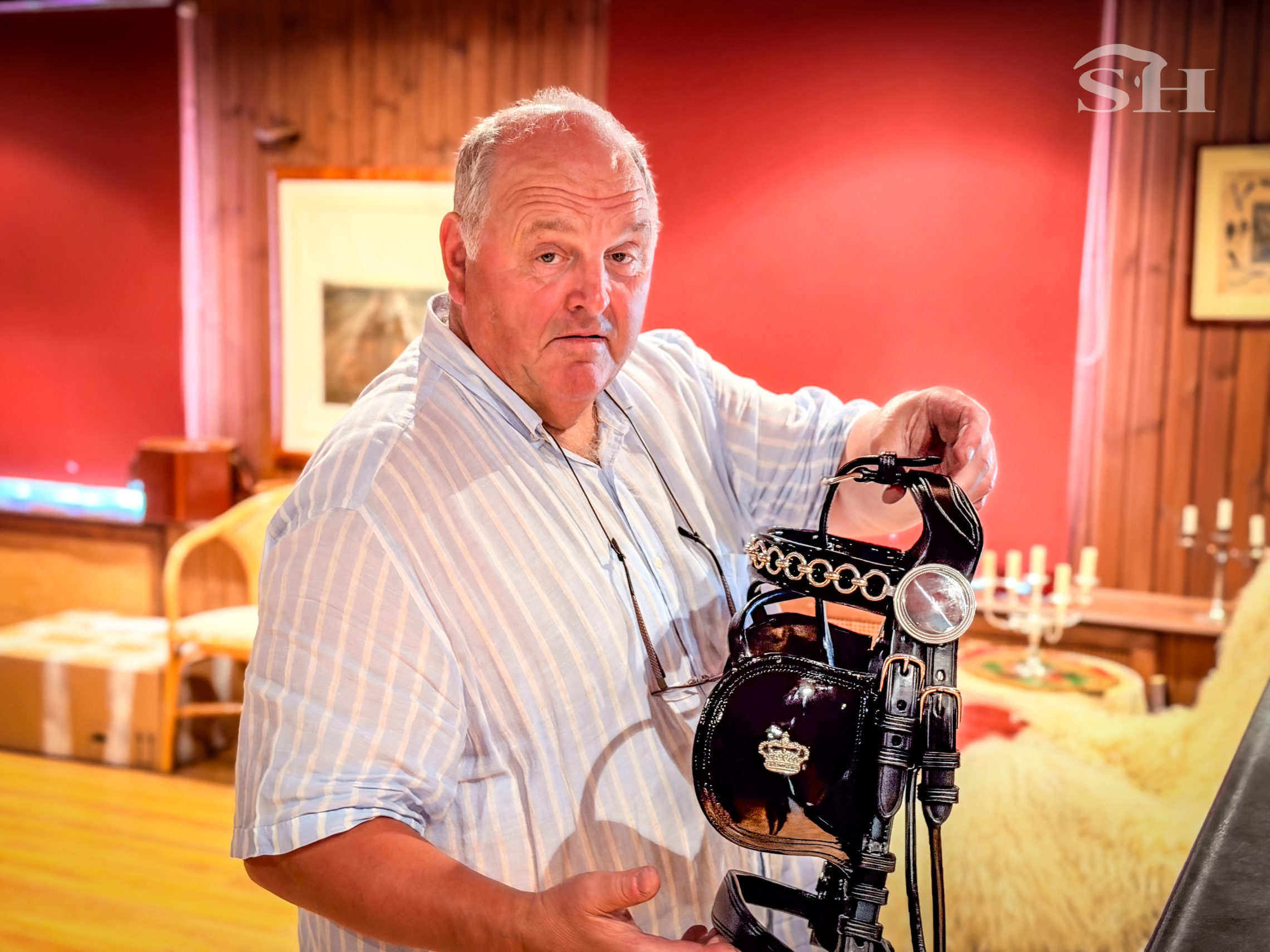
And Henk van der Wiel comes to open the door.
The character quickly fills the doorway. The build of a rugby prop, a handshake that does not seem to have spent its life on a keyboard. Henk has presence. No need to overdo it: two minutes later, the charisma takes care of the rest.
“Come in.”
Enter.
And forget the station.
Welcome to the supplier of kings
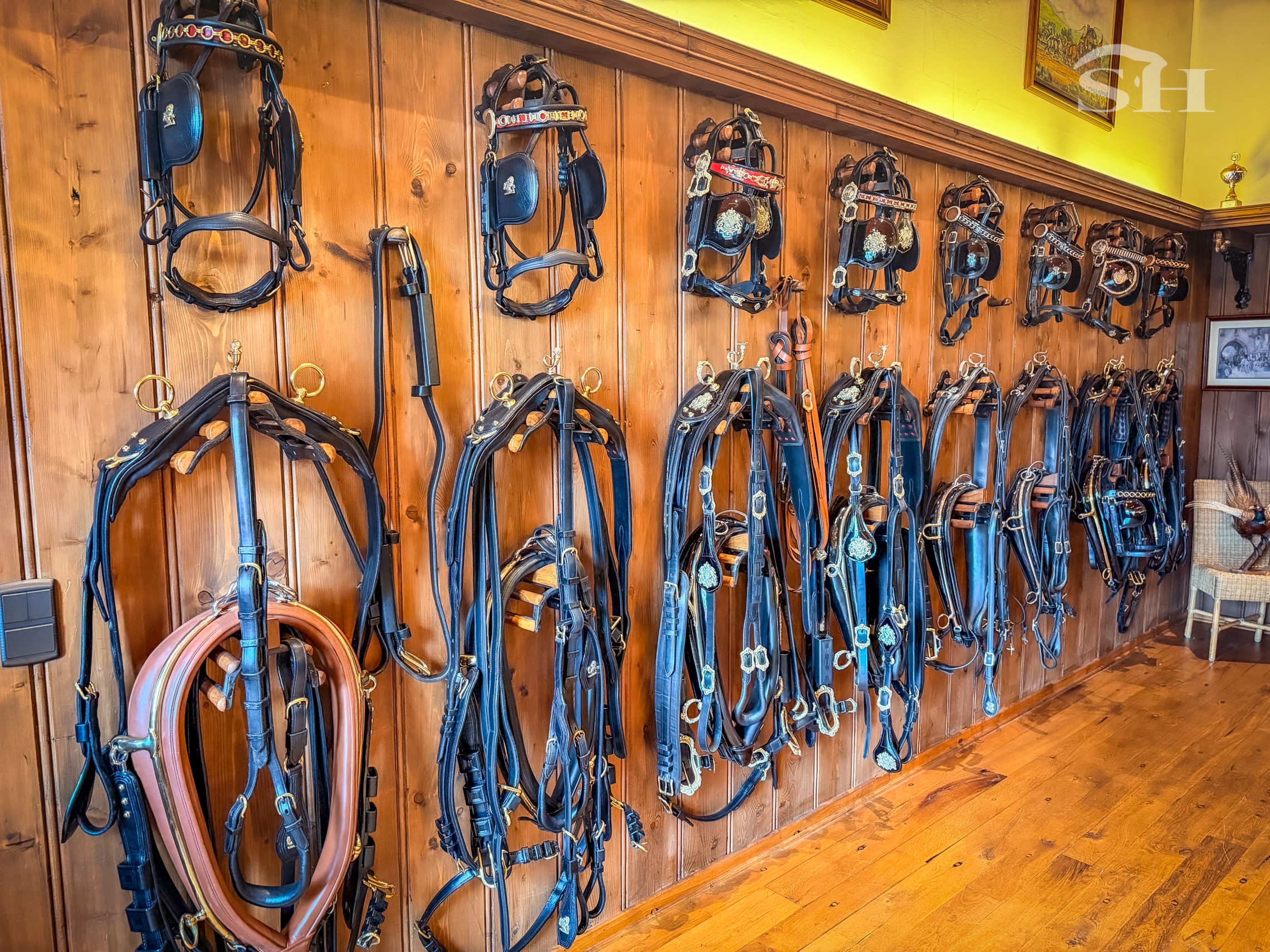
Inside, the setting looks like a fairly unlikely collision between an equestrian museum, a luxury saddlery and the attic of an aristocrat who has devoted three lifetimes to driving.
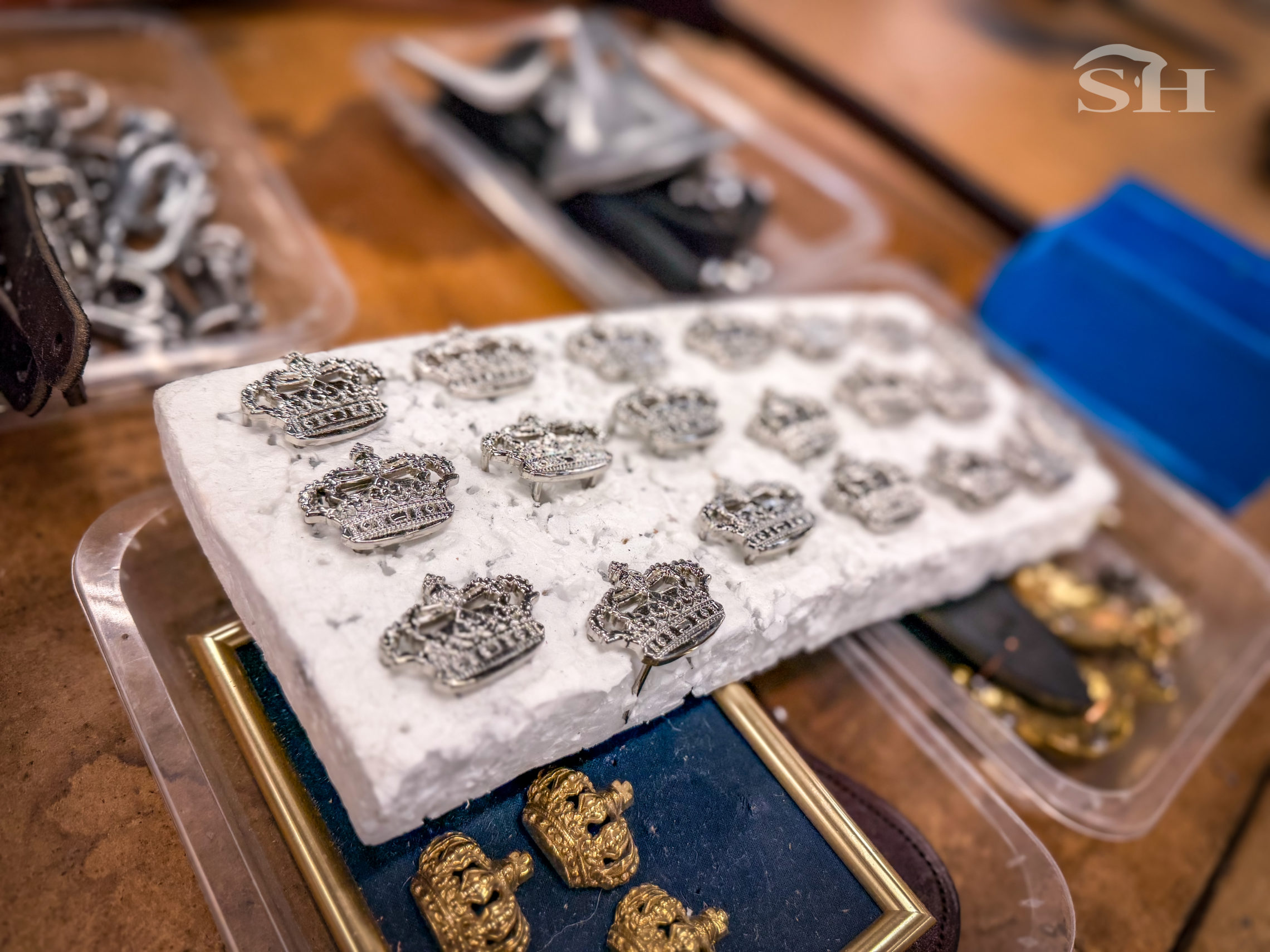
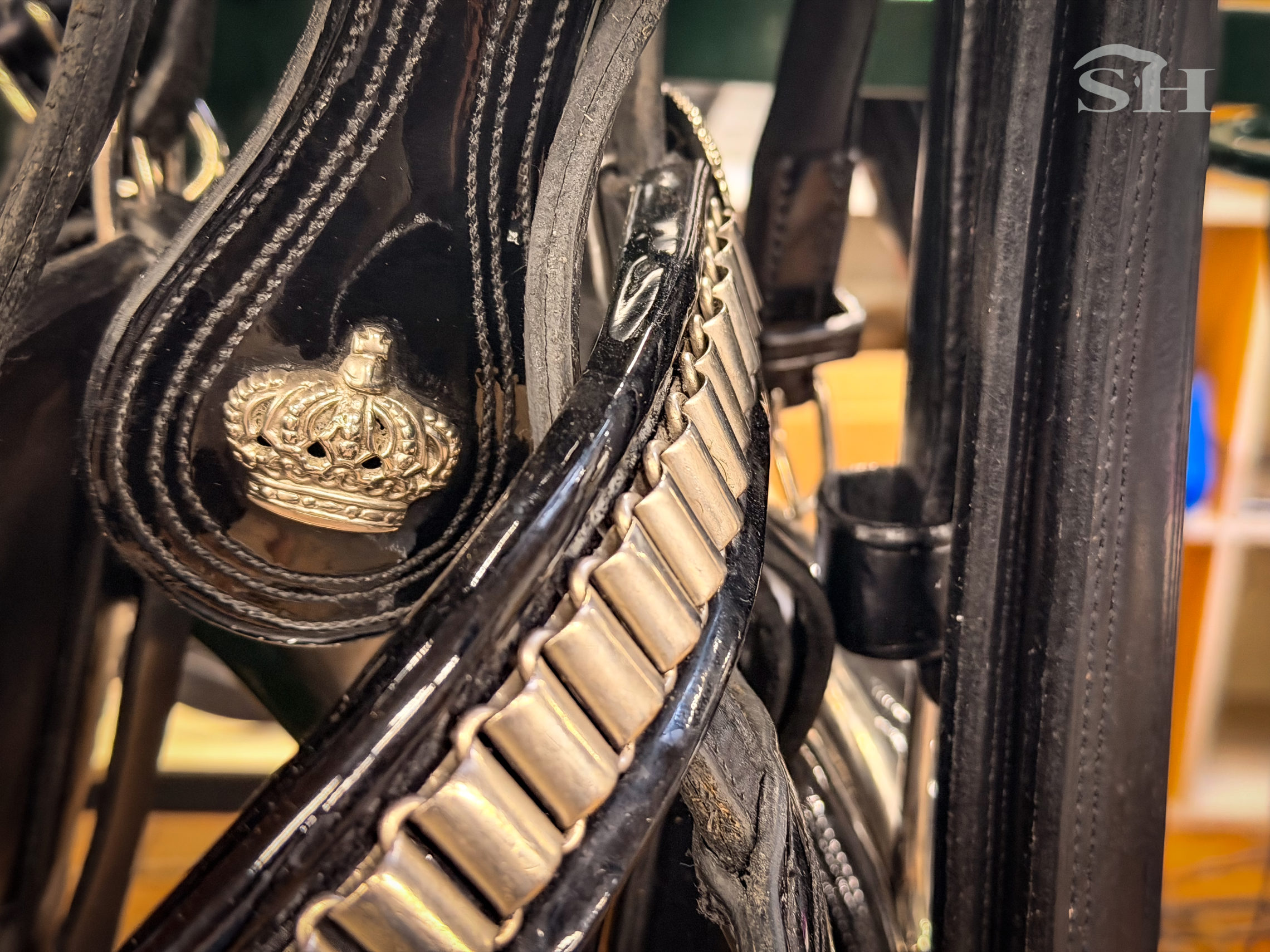
Display cases. Carriages. Life-size horse mannequins. Buckles, bits, pieces of leather, metal crowns and black harnesses shining under the lights. Some are sober. Others much less so. Here, Scandinavian minimalism has not exactly won the battle.
Henk begins the tour.
He stretches out an arm.
This, he explains, is for the Dutch royal house.
A few metres further on, another piece, another story, another crown.
Then come the orders from the great drivers. Glenn Geerts, in particular, for whom the workshop is at that moment preparing a harness intended for the World Championships.
At Van der Wiel, name-dropping does not even need to be organised. It is hanging on the walls.
Henk explains that the story with the Dutch royal stables began with a very concrete problem: finding someone capable of making a collar suited to the massive necks of Friesians. Van der Wiel took care of it. One door opened. Then another.
“After that, the relationships were built. Prince Philip drove a four-in-hand. He needed a harness, so we made one for him. We went to Morocco, to Saudi Arabia… We made harnesses everywhere.”
And not just any Prince Philip: the Duke of Edinburgh, husband of Queen Elizabeth II until his death in 2021. A great driving enthusiast, he was also one of the major figures in the development of the modern discipline. In other words, when the husband of the Queen of England needed a harness for his four-in-hand, the phone call could end up in an old railway station in Belgian Limburg.
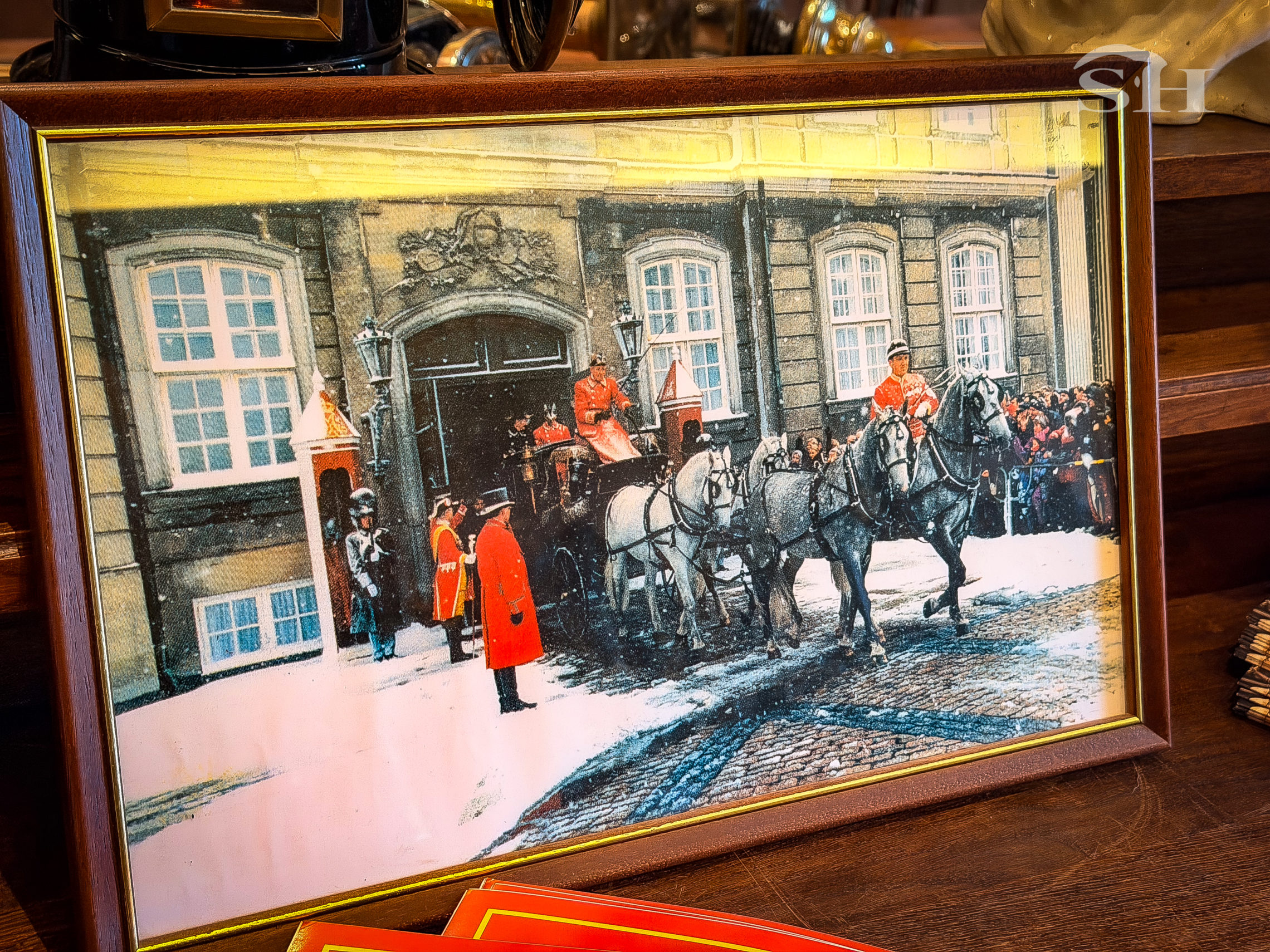
At Van der Wiel, the address book has always had something slightly surreal about it.
But Henk immediately wants to break the image of a supplier reserved exclusively for palaces.
“We work for all the royal houses, but we also make things for the farmer next door. We do everything.”
The king or the neighbour. Same door.
Simply, not necessarily the same number of hours on the workbench.
From 30 to 600 Hours
Because here, luxury is not measured only by the number of crowns screwed onto the leather.
It is counted in hours.
“We can make a harness for one horse in 30 hours. Or in 600 hours. It all depends on the level of finish you want.”
Six hundred hours.
In the age of “delivered tomorrow before 1 p.m.”, the figure almost sounds like an act of resistance.
ome pieces are entirely stitched round. The seams disappear. The leather seems to have closed itself around its structure. Obviously, it has not.
To understand, you have to leave the showroom.
Head for the workshop.
And there, the setting changes.
Here, hands have not yet been replaced
No more display cases. No more staging.
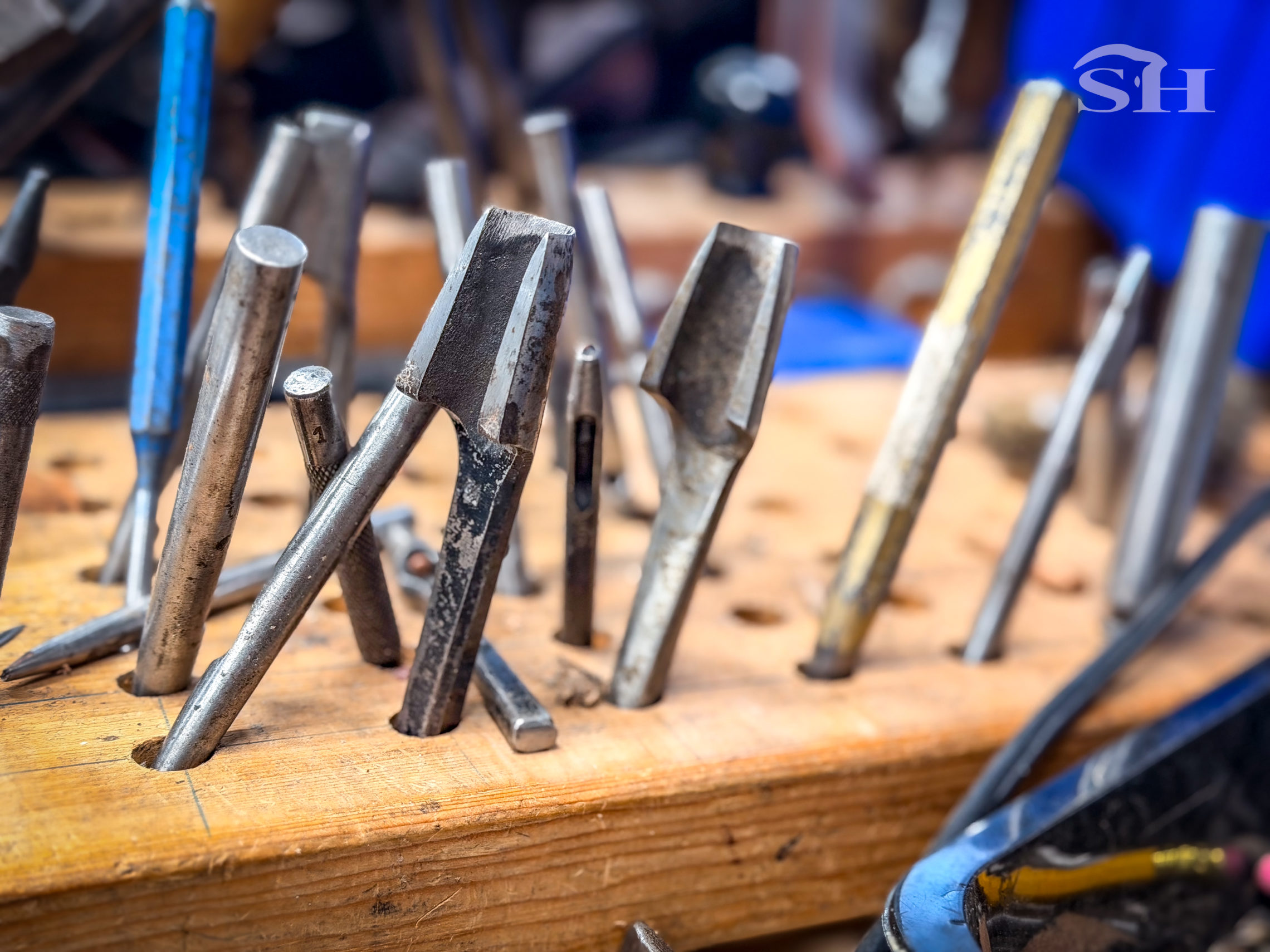
Workbenches loaded with leather. Hammers. Punches planted into wood. Spools of thread. Hundreds of buckles. Offcuts of material. Straps waiting their turn. Metal pieces stored in small drawers according to that mysterious logic only understood by those who have worked there long enough.
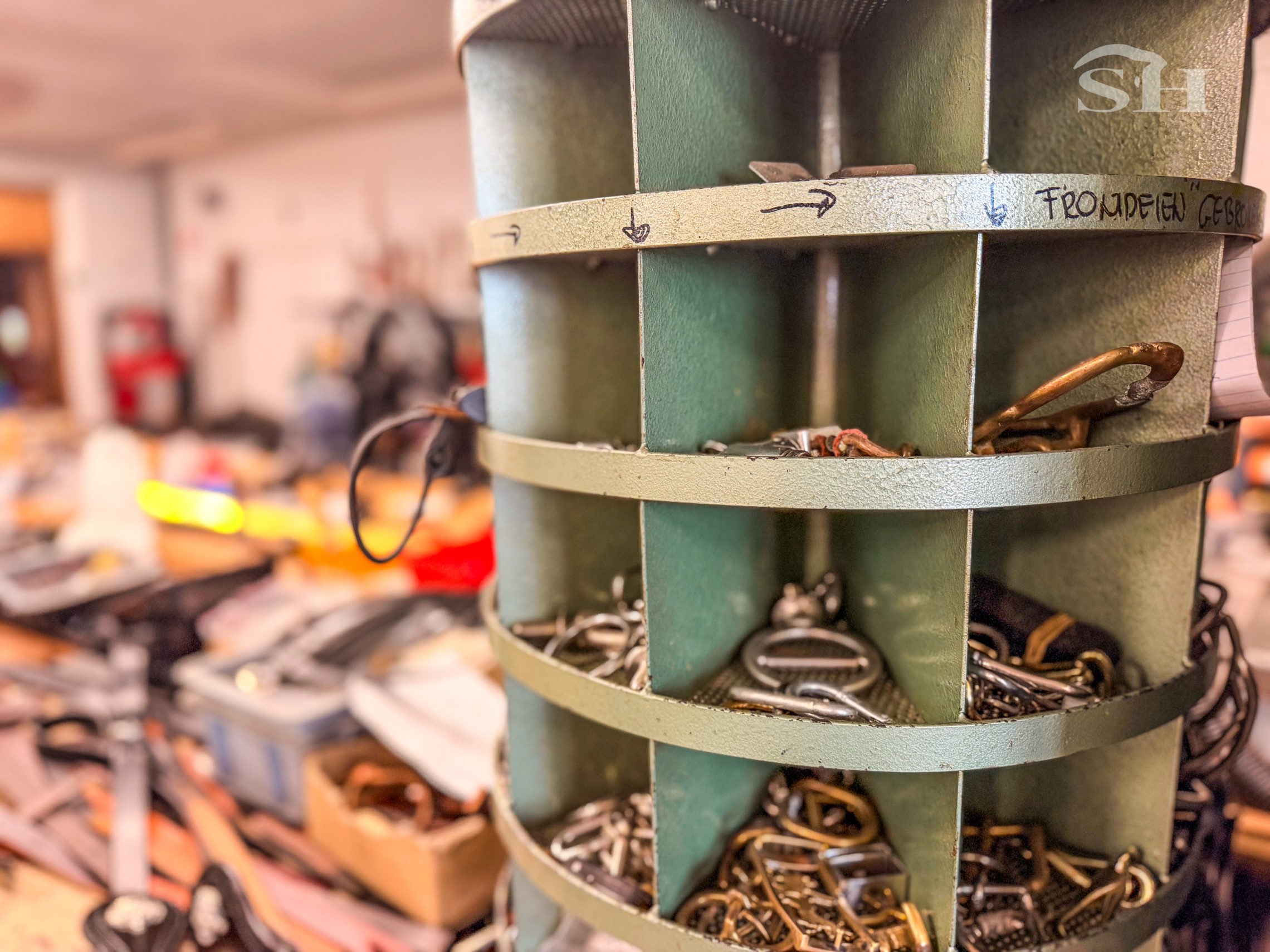
And above all, people.
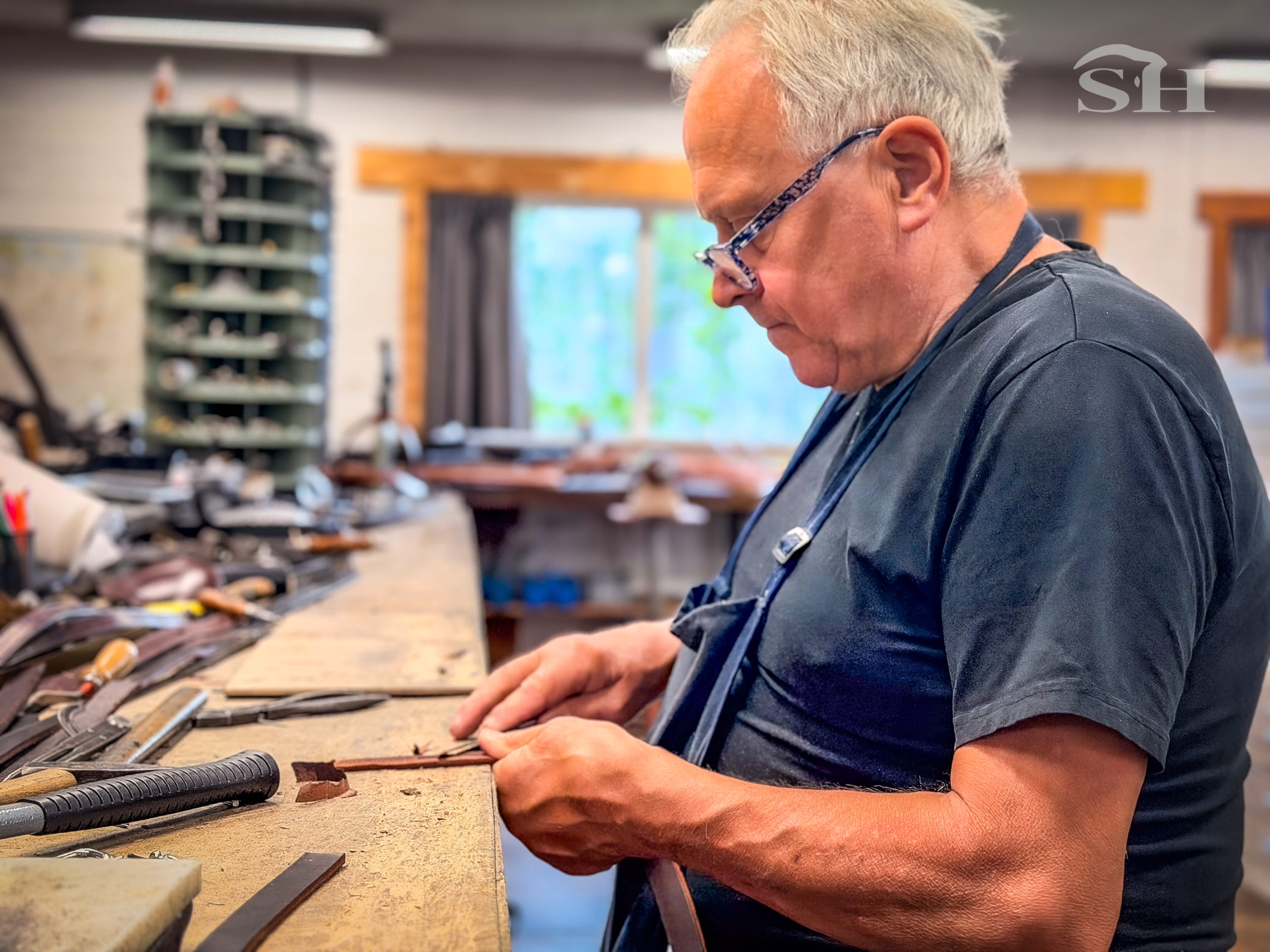
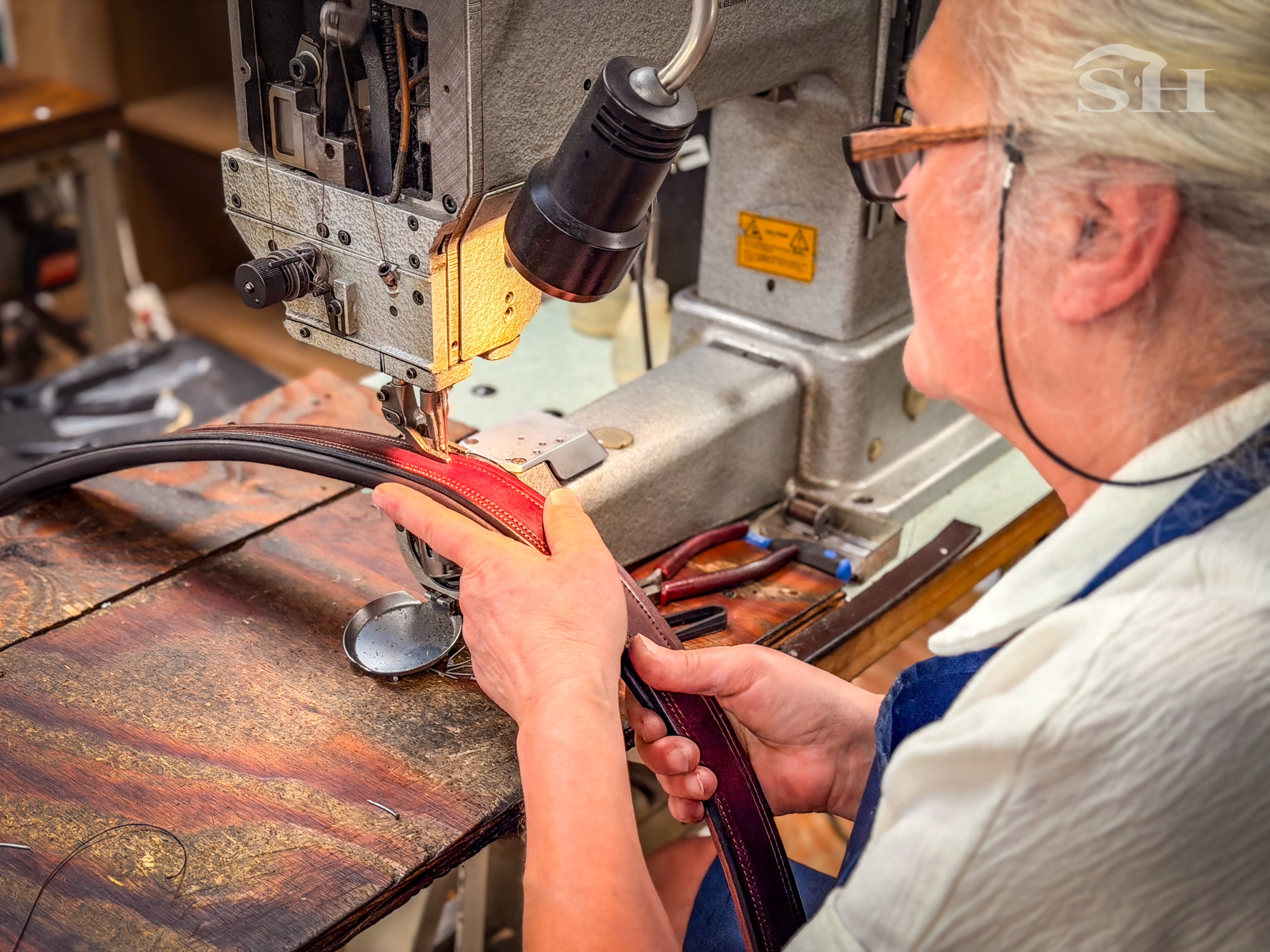
A craftswoman cuts and adjusts a piece of leather. Further away, someone is stitching. At another bench, a hand passes thread around a metal piece. A man works bent over a strap, just a few centimetres from his work.
No robot.
No articulated arm.
No screen announcing that “Harness 4.0” has just revolutionised the industry.
A sewing machine, yes. A few mechanical tools, obviously. But the essential part lies elsewhere.
“Machine work represents maybe 10% of a harness. All the rest is done by hand,” Henk estimates.
And that is probably where Van der Wiel becomes even more interesting than his gallery of royal clients.
Because what you are looking at is not simply a high-end product.
ou are looking at a craft that is shrinking.
Twenty-Five Craftspeople Yesterday, Eight Today
Henk does not romanticise the situation either.
The beautiful craft, the beautiful leathers and the beautiful palace stories do not change the economic equation.
“It is very difficult work. Fortunately, we still have good clients, but everything is copied. It is not as easy anymore. We worked with 25 people. Today, there are still eight of us.”
That may be the most important sentence of the visit.
Because suddenly, the workbenches take on another value.
These gestures that seem to belong to the décor are not guaranteed forever.
In many industries, the human gesture is something people try to eliminate because it costs time. At Van der Wiel, time and the human gesture are precisely what the client comes to buy.
You have to choose the leather. Cut it. Thin it. Shape it. Pierce it. Adjust it. Fit the buckles. Check the angles. Redo a stitch. Polish. Assemble. Take apart. Start again.
The horse, for its part, does not care about the owner’s coat of arms.
The harness has to sit right.
And on that point, Henk has a fairly simple doctrine: start with the best.
“You need good materials. We buy the best leather.”
He also explains that, several decades earlier, he took part in the restoration of pieces for the Hermès museum in Paris, a collaboration that allowed him to be put in touch with the house’s buckle makers.
“We have the best buckle makers, the best leather, and then we try to put all of that together to obtain a harness that fits perfectly.”
Not exactly the secret recipe for Coca-Cola.
Good material. Know-how. And a lot of hours.
ou still have to know what to do with them.
The Boss Also Knows How to Hold the Reins
Because Henk van der Wiel has not observed driving only from his workbench.
He has driven.
A lot.
Five-time Belgian champion, he took part in five World Championships and remains the only pairs driver to have won the Royal Windsor Horse Show.
That competitive past explains part of the house philosophy. At Van der Wiel, you do not design a harness as a beautiful object destined to remain under a glass dome.
It has to work.
Pull.
Resist.
Free the horse’s movement.
And survive a marathon.
“I listen to the drivers. I am a driver myself, so I know more or less how everything works. But there are always new ideas.”
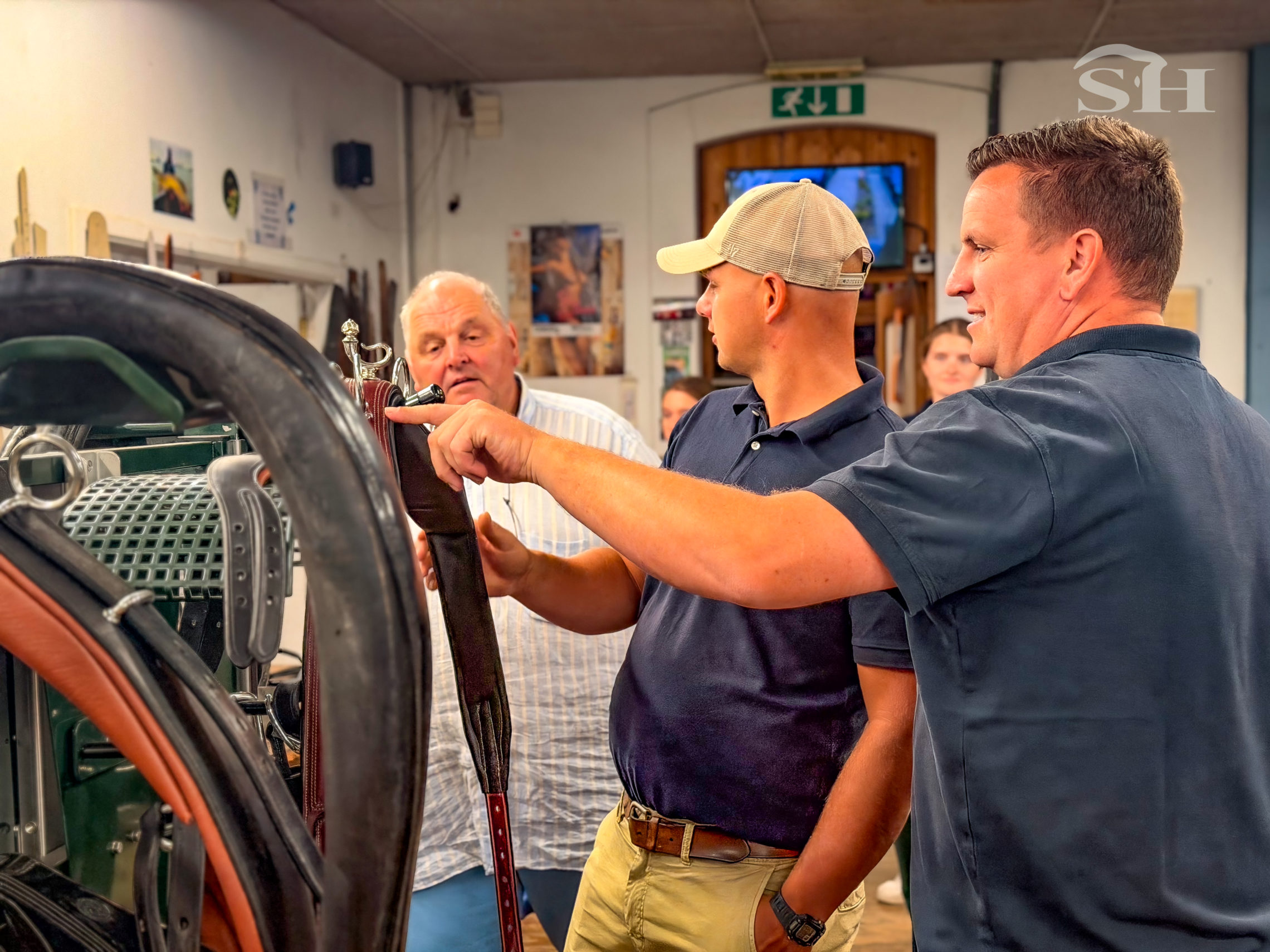
He mentions in particular the movable traces inspired by an idea from multiple world champion Boyd Exell.
Then he lets slip a sentence that sums up the character rather well:
“I try not to be blind, because there is always someone with a better idea.”
For a man who could spend the entire visit explaining that he knows better than everyone else, that is rather refreshing.
43 drivers out of 48
t must be said that Van der Wiel no longer has much to prove in sport driving.
One of the house’s peaks came at the World Championship in Jerez in 2002:
“There were 48 drivers and 43 were using my harnesses.”
3 out of 48.
But Van der Wiel’s sporting story had begun much earlier.
In the 1970s, he notably started making marathon harnesses, at a time when the modern discipline was still young. One of his first major clients was the Dutchman Tjeerd Velstra.
“After Tjeerd Velstra, I think we had practically all the four-in-hand drivers in the world in the following years,” Henk recalls.
The little saddlery in Achel had just changed dimension.
Without really changing method.
Twelve Horses, and a Few Crowns
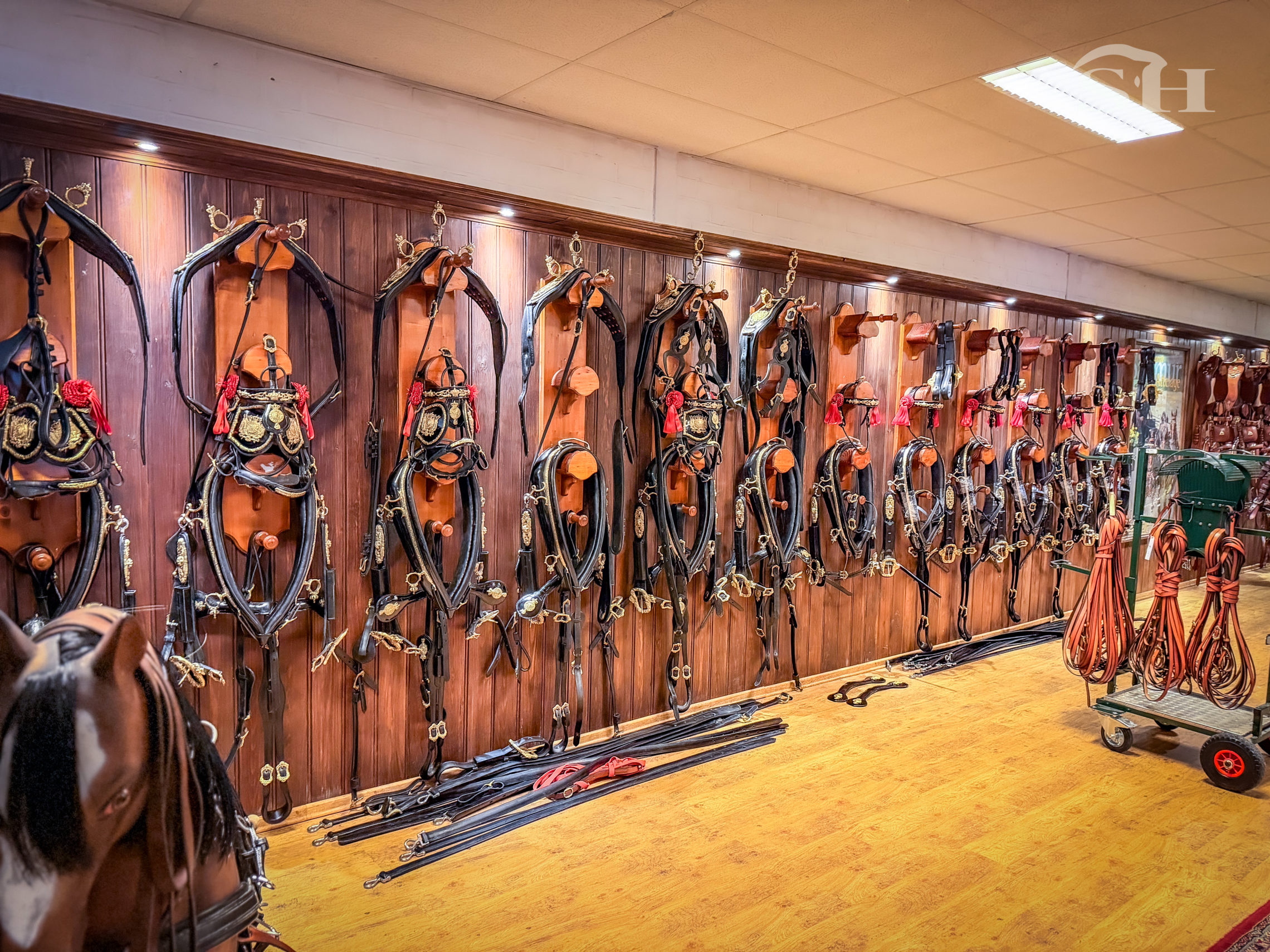
Back in the showroom.
Henk now points out a monumental piece.
A gala harness intended for a twelve-horse turnout.
Twelve.
At that level, preparing the Sunday-morning carriage drive starts to look like the logistics of a small airline.
“It is really a masterpiece,” he says.
The black leathers line up. The metal fittings catch the light. Crowns and coats of arms return everywhere. In the display cases, they exist in every size, silver or gold, ready to sign a piece.
And then there are the dummy horses, fully harnessed, which give the place its strange atmosphere. You could almost expect them to set off with the carriage parked behind them.
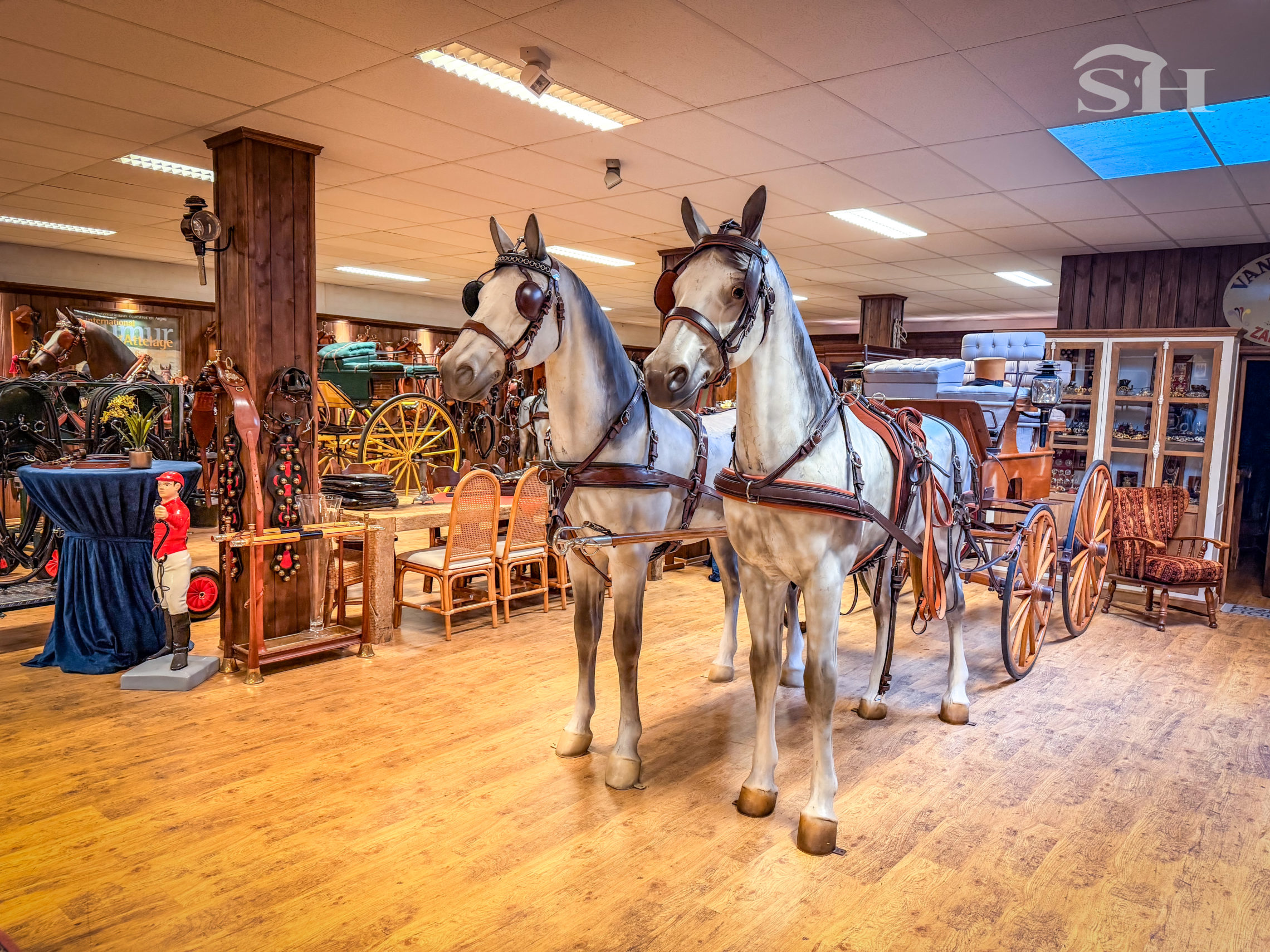
This old station no longer sends out passengers.
It sends out leather.
“The farmer next door and the king”
In the end, this contradiction is what best tells the story of Henk van der Wiel.
He works in a world of kings, world champions, gala carriages and coats of arms. But his workshop remains a workshop.
You drink coffee next to leather offcuts.
You put a hammer down on a bench marked by thousands of blows.
You still make a piece with your fingers because no machine knows exactly how to do what is expected of it.
Henk says it much better:
“We make for the farmer next door and we make for the king.”
In both cases, the leather passes through the same hands.
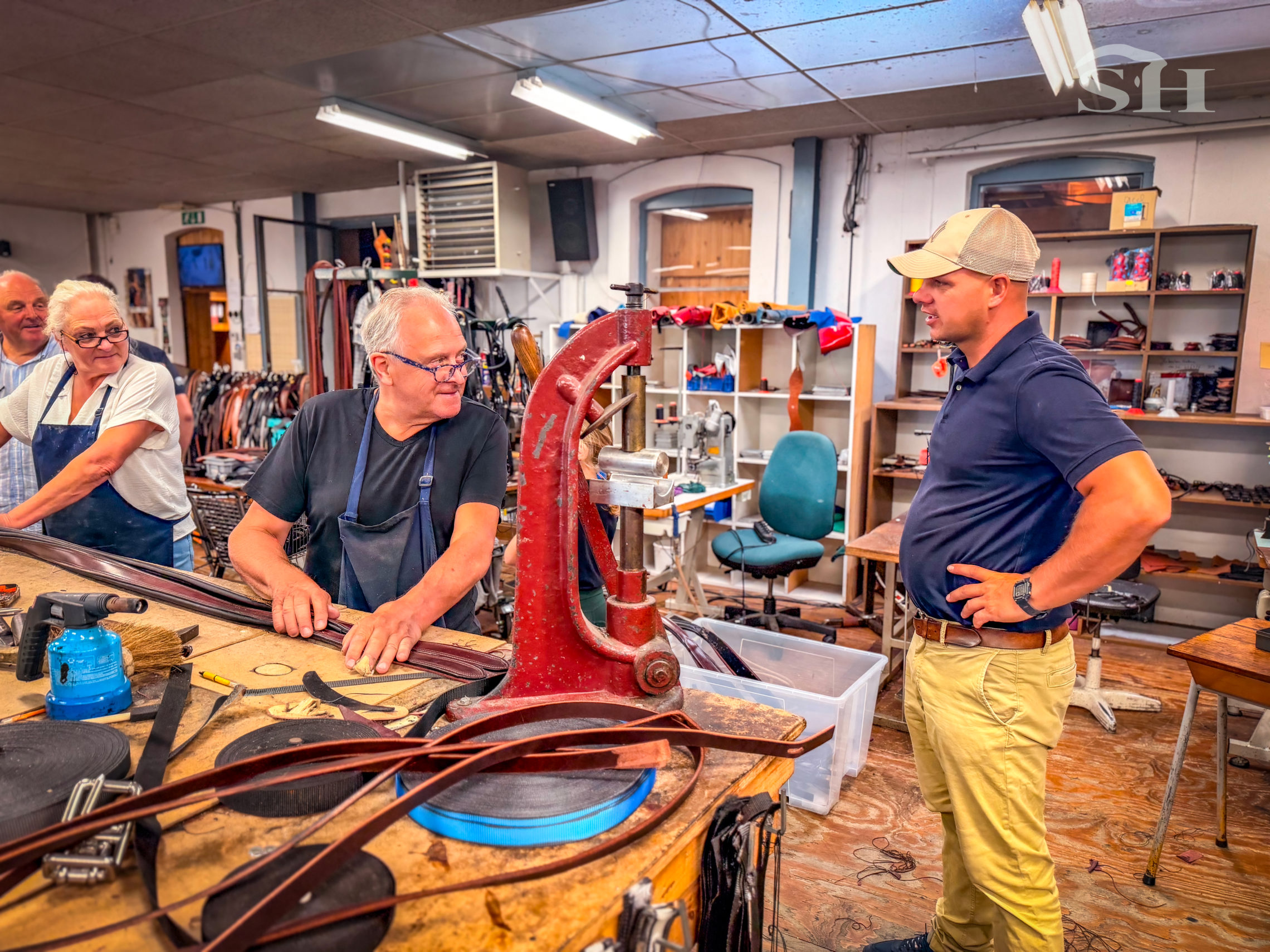
And Tomorrow?
Henk is now more or less retired. His wife is English and he spends part of his time in England.
The workshop, however, continues.
With eight people.
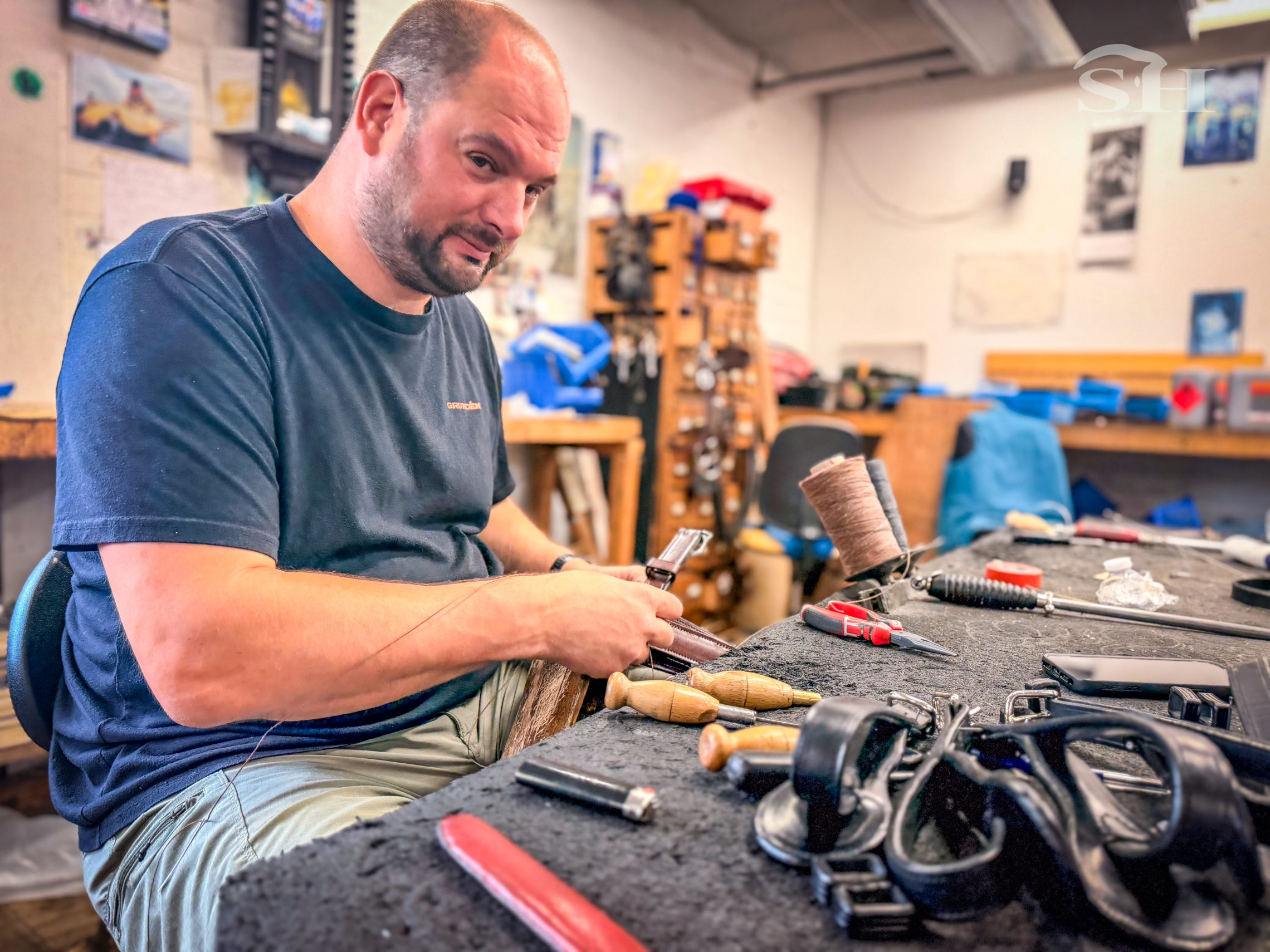
The question of the future inevitably hangs over the workbenches. Especially as top-level driving, its historic market, is itself becoming an increasingly expensive discipline.
Henk sees more future in ponies and single-horse driving. For the four-in-hand, the equation is becoming formidable.
“You have to be completely professional if you want to do something. You need two grooms. Who pays?”
In his eyes, driving also suffers from a lack of readability for sponsors.
“In dressage and showjumping, you find sponsors who want to be there. Our sport is too difficult to understand.”
And paradoxically, the higher the level rises, the more the bill follows: better horses, more training, more staff, more travel.
The sport is modernising.
The workshop, meanwhile, has to find a way to survive without losing precisely what gives it its value: its slowness.
The Rolls of Driving?
At the end of the interview, a comparison is attempted.
Could Van der Wiel be a little like the Rolls-Royce of driving harnesses?
Henk pauses.
Smiles.
“If you say so, then I can say yes.”
And he laughs.
Then the tone shifts slightly.
Because behind the royal houses, the World Championships and the harnesses requiring 600 hours of work, there remains a much simpler story.
“I am very proud of what we have done. When we started, we were in a wooden building eight metres by five. Twenty square metres were my home and twenty square metres were my workshop.”
He points to something on the wall.
That is where it all began.
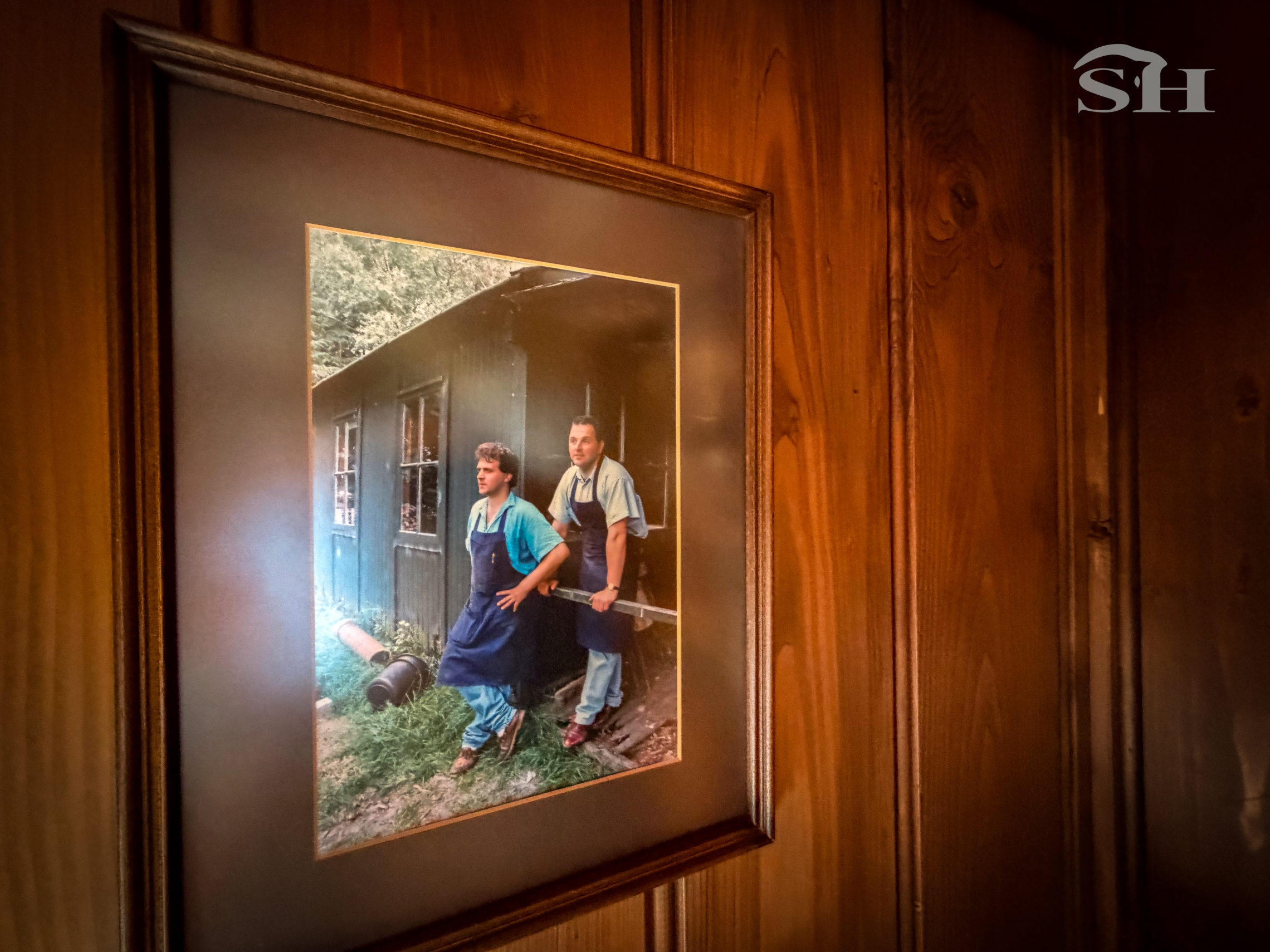
A cabin of just a few square metres.
Leather.
Horses.
And hands.
orty years later, trains no longer stop at the old station in Achel. But behind its doors, pieces are still being made that will travel to the four corners of the world.
Some will carry a crown.
Others will simply pull a carriage on a Sunday.
Henk van der Wiel does not seem to make much of a distinction.
The king or the farmer next door.
As long as the harness sits right.